Paul Kirby,Europe digital editorand
Chris Graham

 Reuters
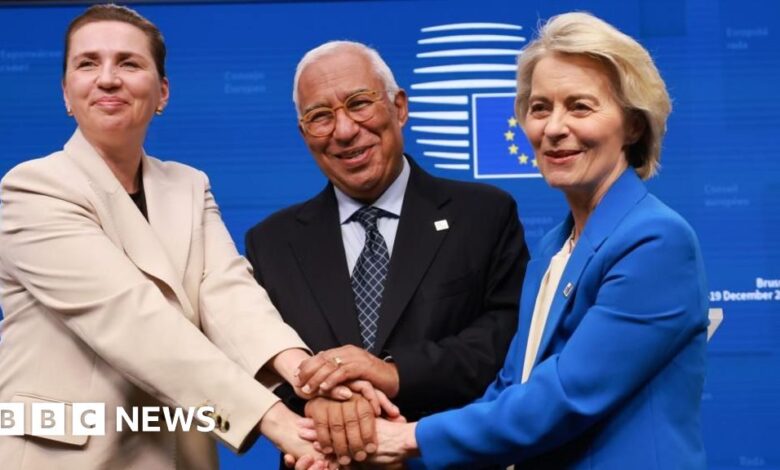
European Union leaders have struck a late-night deal to lend Ukraine €90bn (£79bn; $105bn) over the next two years, after failing to agree on using frozen Russian assets.
Ukraine was set to run out of cash by next spring, and European Council chief António Costa said the loan would be paid back only when Russia paid reparations for its full-scale war.
“We committed, we delivered,” said Costa and Ukrainian Prime Minister Yuliya Svyrydenko praised the deal as “a decisive step for economic resilience”.
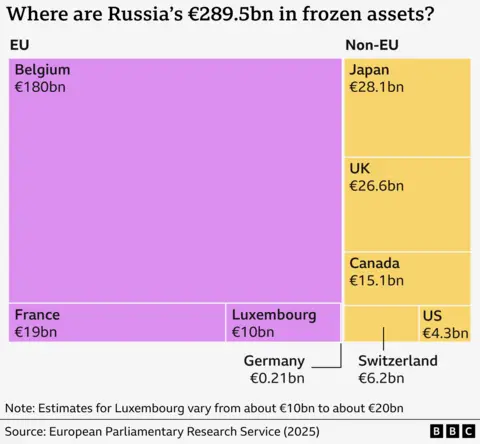
A bid to use €210bn in Russian cash frozen in the EU, mainly in Belgium, ultimately failed as leaders could not convince Belgium’s prime minister he would be protected from Russian retaliation.
The bulk of the cash is held by Brussels-based Euroclear and interest from the frozen assets is already being paid to Ukraine. Meanwhile, Russia has launched legal action against the clearing house.
Russian President Vladimir Putin accused EU leaders of attempted robbery on Friday and his US talks envoy Kirill Dmitriev claimed their failure to agree on using the assets was a “fatal blow”.
However, Belgium’s Bart De Wever said the deal eventually agreed after almost 17 hours of talks was a “victory for Ukraine, a victory for financial stability… and a victory for the EU”. EU leaders had avoided “chaos and division”, he added.
Ukraine needs an estimated €137bn over the next two years to cover both its military and its public services, and the EU plan is to cover two-thirds of that.
The €90bn that the EU will raise on the capital markets as part of the loan deal for Ukraine will be “backed by EU budget headroom” – that’s the margin between actual EU contributions by member states in a year and the maximum the Commission can spend as part of the budget.
Ukrainian President Volodymyr Zelensky said he was grateful to European leaders for the “significant support that truly strengthens our resilience”.
Germany’s Friedrich Merz had been a strong supporter of the plan to use Russia’s frozen assets. Although the idea has not been dropped, the decision to borrow the money against the EU budget instead is seen as a setback for him. Nevertheless he declared that it “sends a clear signal from Europe to Putin”.
Two countries, Hungary and Slovakia, refused to back the compromise deal, while the Czech Republic said it would not guarantee the loan.
Hungary’s Viktor Orban, seen as Vladimir Putin’s closest partner in the EU, has opposed handing any more money to Ukraine, arguing it prolongs the war, and he condemned the deal.
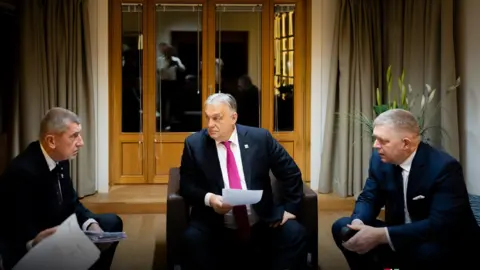 Viktor Orban/X
“It looks like a loan, but the Ukrainians will never be able to pay it back,” he told reporters. “It is basically losing money.”
Like Orban, Slovakia’s Robert Fico refused to back more funding to allow Ukraine to continue its defence against Russia, but Czech Prime Minister Andrej Babis was careful to point out he agreed to the summit’s conclusions “on condition we don’t guarantee the loans”.
Billionaire populist Babis only just formed a government this week, and his stance is a signficant departure from the previous government’s staunch support for Ukraine.
The EU summit took place as US talks with Russia were set to continue, spearheaded by US President Donald Trump who said this week that a solution was closer than ever.
Putin envoy Kirill Dmitriev is expected to meet Trump envoys Steve Witkoff and Jared Kushner in Miami at the weekend, according to reports.
Meanwhile, a Ukrainian delegation is also due in Miami for talks with their US counterparts, days after Kushner and Witkoff met them and European leaders in Berlin.
The Europeans have made a series of proposals to end the war which include a multinational force as part of “robust security guarantees” for Ukraine.
Putin has criticised the European approach, saying he had already agreed to several compromises at his meeting with Trump in Alaska last August. Praising Trump’s “serious efforts to end this conflict”, the Russian leader said “the ball is entirely and fully in the court of our Western opponents… the head of the Kyiv regime and its European sponsors.”
Putin’s demands were largely reflected in an initial US peace plan and include Ukraine handing over large areas of its own territory.
Polish Prime Minister Donald Tusk said the deal agreed by the EU boosted the Ukrainian position: “There is a chance that these negotiations will be about peace not on Russian terms, but on terms that can somehow be accepted and considered acceptable by all parties to this conflict.”
Meanwhile, French President Emmanuel Macron said he believed it would be “useful” for Europe to re-engage with Putin.
“I believe that it’s in our interest as Europeans and Ukrainians to find the right framework to re-engage this discussion,” he said, adding that Europeans should find the means to do so “in coming weeks”.
https://ichef.bbci.co.uk/news/1024/branded_news/c01b/live/b40edb10-dc8c-11f0-b67b-690eb873de1b.jpg
2025-12-19 12:47:56